
Why Prevention?
Substance Use Prevention is a Critical Component of the Continuum of Care
Prevention is the first step in the National Institutes of Health (NIH) Continuum of Care, which spans from health promotion and prevention to treatment and recovery support. Its goal is to stop substance use before it starts, reducing the need for intensive interventions later.
At PACE Coalition, we regularly assess substance use in Northeastern Nevada to understand what substances are used, where and by whom, community attitudes, and available resources. We also identify risk factors that contribute to substance use and protective factors that can help prevent it. This assessment becomes a planning tool to guide the development of a Comprehensive Community Prevention Plan.
The Role of Prevention in the National Institutes of Health (NIH) Continuum of Care
The continuum includes:
- Promotion: Building healthy environments and behaviors.
- Prevention: Targeting risk factors and strengthening protective factors.
- Treatment: Addressing substance use disorders.
- Recovery Support: Sustaining long-term wellness.
Prevention is foundational because it reduces the incidence of substance use disorders and related health, social, and economic consequences.

The NIH Continuum of Care places Prevention at the foundation, spanning Universal, Selective, and Indicated approaches, within a broader framework that includes Treatment, Recovery, and Maintenance — all built on a base of health Promotion.
Prevention Strategies
Universal
Universal strategies are designed for everyone in a given population (i.e. state, city, school), regardless of their level of risk. These approaches aim to promote healthy behaviors and prevent substance use before it starts. Examples include:
- Community-wide education campaigns
- School-based prevention programs for all students
- Public policies like restricting alcohol sales to minors
Goal: Reduce overall risk and strengthen protective factors across the entire community.
Selective
Selective strategies target specific groups or subpopulations that are at higher-than-average risk for substance use. These groups may share certain characteristics, such as:
- Living in areas with high substance use rates
- Having family histories of substance misuse
- Experiencing economic or social challenges
Examples include:
- Prevention programs for youth in high-risk neighborhoods
- Support groups for children of parents with substance use disorders
Goal: Address elevated risk factors before substance use begins.
Indicated
Indicated strategies focus on individuals who are already showing early signs of substance use or related behavioral issues, but who do not yet meet diagnostic criteria for a substance use disorder. These interventions are more intensive and personalized, such as:
- Brief interventions for teens caught using substances
- Counseling for individuals with early behavioral problems linked to substance use
Goal: Prevent progression to more severe substance use or addiction.
SAMHSA's Strategic Prevention Framework (SPF)
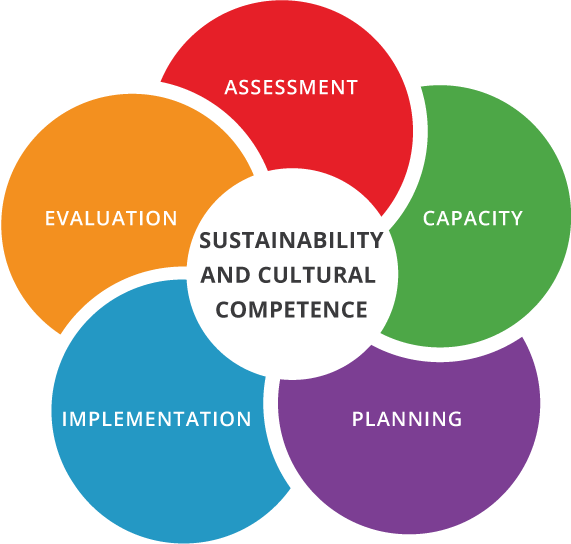
SAMHSA’s Strategic Prevention Framework guides communities through five steps — Assessment, Capacity, Planning, Implementation, and Evaluation — with Sustainability and Cultural Competence informing every step.
The SPF is a five-step, data-driven process for building effective prevention programs:
- Assessment
Identify local needs, risk and protective factors, and resources. - Capacity
Build partnerships and strengthen prevention infrastructure. - Planning
Develop a strategic plan using evidence-based practices. - Implementation
Deliver programs and policies that address identified needs. - Evaluation
Measure effectiveness and improve future efforts.
Sustainability and Cultural Competence are guiding principles throughout the SPF.